Showing posts with label handspun. Show all posts

Tuesday, January 24, 2012

Great Scot!

I wanted to get something on the wheel as soon as the sea foam green oddness came off… so I reached for the Spinner’s Sampler I got at the PA Farm Show earlier this month.  First up: Shetland!IMG_0601Good thing I have a couple of reference books on hand.  From Clara Parkes’ The Knitter’s Book of Wool, we learn that Shetlands fall into the category of “Northern European Short-Tailed” sheep and are cousins to Finn and Icelandic sheep.  The fiber can vary quite a bit in terms of staple length and softness.  Even on the same animal, one can find 5 different types of fiber.  The really, really fine stuff is what they make the famous Shetland lace wedding shawls out of (the ones that can pass through a wedding band).  Mine wasn’t that fine.  Oh, and Clara says that Shetland wool is typically spun in the woolen style so that those short, crimpy fibers can bloom.  OOPS!  I spun in more of a worsted style (which is my fallback style).  I let a little twist into the fiber mass, so I suppose it was a hybrid technique.  (All this Shetland info is from pages 75-76.)

That may explain why my finished yarn feels a bit rough.

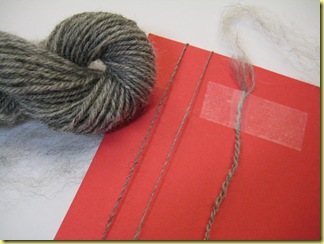
Okay, so I started out with one ounce of fluff that looked like this:IMG_0516 I spun the singles on my 14:1 whorl on my Ladybug.  The bobbin looked like this as it started to fill:IMG_0554I LOVED how lively this fiber felt as I worked with it.  It was so much more substantive than the alpaca-wool sliver I worked with most recently.  It had a bit of lanolin left in it, and it smelled sheep-y – but in the best possible way.  I was very disciplined and made a little sample card this time.  It shows the singles and a small piece of 2-ply.  The idea is to use this as a reference to achieve a more consistent single.  Check out the single up close – doesn’t it look springy and alive?

IMG_0559

IMG_0560

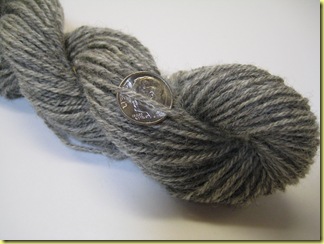
Since I only have a small amount of this fiber, I spun it all on one bobbin and then navajo-plied it on my next bigger whorl (12.5:1).  This produced a 3-ply chained yarn.  I know you’re not supposed to try navajo ply with long-stapled wools and this one wasn’t…IMG_0599I have 61 yards of finished yarn, and the skein weighs exactly one ounce. It was really twisty when it came off the niddy noddy but calmed down a lot after its hot water bath.  The skein was still slightly unbalanced, though (and I didn’t determine whether it was underplied or overplied).  I wonder if navajo plied yarns are ALWAYS super twisty when they come off the niddy noddy?  Anyone know?  I could really use a spinning mentor!IMG_0603 Deb Robson’s The Fleece & Fiber Sourcebook devotes a full 10 pages to the Shetland breed, including some gorgeous photo spreads of the sheep themselves, the fiber, and yarn and cloth made from the fiber.  She says Shetland is a “conservation” breed.  I didn’t find a precise definition of this, but it isn’t as bad as “critical conservation breed” (which is globally rare and on the precipice of extinction) or “extinct” (p. 6).  It shows a skein of Garthenor Shetland yarn that looks super yummy.  I could see myself knitting a sweater out of this stuff.
There is a Ravelry group for The Knitter’s Book of Wool (of course there is!) and they’ve been studying breeds since it came out.  Back in August 2010, they focused on Shetland (I’ll look forward to reading the backfile).  Here is the breed description that’s posted there:

Shetland: This hearty, short-tailed, longwool sheep is actually a Primitive or landrace rather than a breed, meaning that Shetlands breed other Shetlands all on their own, if you get my drift. Because of their diversity, many colors and patterns of Shetlands developed, though some colorations have dwindled as shepherds have selected for easy-to-market white fleeces. Their 11 remaining colors and 30 pattern variations are codified using terms that derive from Norn, the Germanic language formerly spoken on the Islands. Their ancestors were most likely brought to their North Sea Island homes by Scandinavian settlers more than 1000 years ago: Shetlands are related to Finns, Icelandics, and other Scandinavian sheep. They’re the smallest British breed. The ewes are polled, while the rams have beautiful spiraling horns. When well tended and fed, Shetlands produce fine-crimped, long, soft wool between 20 and 30 microns, and the sheep will roo if given the chance, and some are double coated, revealing their Scandinavian ancestry. The harsh climate of the Shetlands has helped these sheep develop a great independent streak—Shetlands can handle harsh climates and terrains, and are very quick witted. That independence makes them easy to care for, and their small size keeps feed costs down.

Hmmm, that description says “longwool” – did you notice?  Again, could use a spinning mentor.

I haven’t started spinning another breed yet.  Would you care to vote?  Other choices in the sampler include Lincoln, Coopworth, and Romney.

Monday, January 16, 2012

New year, new yarn

Well, I finally finished spinning that little 4 oz bag of alpaca/wool that I started waaaaay back in November. I’m not that impressed with my yarn.  I got 278 yards of 2-ply:2-ply fix

You can see that the two plies aren’t very even.  I need to make a better effort when it comes to consistency.  I also need to work on plying – I just get so confused when I read articles about calculating the angle of twist and how I’m supposed to be able to see that without some scientific apparatus. 

Even though I divided my fiber in half and spun each half on its own bobbin, I had kind of a lot left over on one bobbin.  So I rewatched the navajo ply video and finished up the remaining singles.  Remember, navajo ply creates a chained 3-ply yarn.  This should look “rounder”:3-ply fix I have only 30 yards of this.

I spun the singles on my 10.5:1 whorl and plied them one size bigger (9:1).  I read somewhere that you should ply on the next whorl size up, so I tried that.  Not sure it made a huge difference on the two-ply.  It did make the navajo ply more manageable.

I’m resolved to keep on doing this until it gets better.  I think I’ll spin up those little bags in the spinner’s sampler I got at the farm show.  Since they are samples (1 oz each), I guess I’ll navajo ply so I don’t have to worry about dividing and then having leftover singles.

I keep reminding myself that I’ve put a LOT more practice into knitting than I have into spinning, and what I’m getting is still fairly beginner-level handspun.  I just need more practice.  Gotta get back on that horse. 

And I also want to start knitting more with my handspun.  I think that will help, as well.  My sock knitting improved considerably once I started wearing my own socks rather than giving them all away.  One gives oneself the most honest feedback!

Tuesday, June 28, 2011

We’ve got yarn

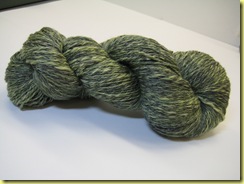
I finished up a skein of yarn last night:IMG_9137This is the grey-ish green stuff I got from Bullen’s Wullens at MDSW last month – it’s 50/25/25 merino/bamboo silk.   And it’s pretty fine, even with 3 plies.  I spun the singles on my smallest pulley (16:1) and plied on the next smallest (14:1) – I did this because I read a Spin-Off article by Judith MacKenzie that said to ply on the next largest pulley size when making worsted-style yarn (you do the opposite with woolen spun yarn).  I’m not sure I love that.  The yarn has less twist than I expected it to.  I guess I could run it through the wheel again to add more twist...IMG_9133 I got 409 yards out of this and it weighs 124 g (the label said approximate weight 112 grams, so they were generous).  Is it thin enough to be sock yarn?  Maybe.  I did a little math, and in only 100 grams of yarn (standard amount for socks) I have 330 yards.  Felici has 426 yards/100 grams.  Regia sock yarn has 460 yards/100 grams.  Koigu has 350 yards/100 grams.  So maybe I’m not quite there yet.  I don’t think I would use this fiber blend for socks, anyway. It’s destined for something around the neck. IMG_9138

I’m not sure what I think.  The way the colors look plied reminds me of that sock yarn with chitin in it (TOFUtsies), and I never liked that look very much.  But once it’s knit up, it may be fine.  It’s a moody color, that’s for sure.  I had a heck of a time photographing it.  Usually everything looks better in outdoor light.  Not this!  I couldn’t get the greens to show up.  Look, here’s the yarn against grey stone – it doesn’t really surprise me that the green gets washed out against all the grey:IMG_9128 But I thought that putting the yarn against green would bring out the green, and it doesn’t.  See?IMG_9127 It actually looks a tiny bit better – and also bluer - against this yellow table!  I know that blue and yellow make green, but why would green and yellow make blue?IMG_9129The yarn is really and truly green, which came out best in photos taken INDOORS (but with lots of indirect light):IMG_9134I’m no color expert or photography expert, so if you can explain this to me, I’m all ears.

Monday, May 30, 2011

A new home for the handspun

Do you remember that autumnal BFL I spun up?  Well, Judy has knit it up, and it is gorgeous!IMG_8978 She picked a simple infinity scarf pattern, which can be worn looped twice for a snug fit or left long:IMG_8976 It really does look beautiful.  She was able to use almost every last bit of the yarn, too.  This will be so cozy come fall.  Great choice of pattern.

I really should get back to my wheel…

Sunday, September 19, 2010

Sock yarn … ?

Here is what my 50/50 BFL/mohair from Bedford looked like as singles in three bobbins:IMG_7128

And here it is all plied up:IMG_7138 Total yardage is 308 yards and it weighs 4.1 oz (116 grams).

IMG_7147

Is it sock yarn?  Ummmm….. maybe sport weight sock yarn. 

Most sock yarn comes in 100 g put-ups.  If I express the yardage I got in terms of yards per 100 g, I got 266.

Compare to Felici fingering sock yarn at 436 yards/100 g, or Felici sport sock yarn at 328 yards/100 g.  Not so close.

BUT….  I think mohair might be heavier than wool.  I couldn’t verify this quickly in either of the Clara Parkes books on my shelf, though, so I’m just not sure.

Hmmm.  I’ll just have to keep spinning to figure this out.

Thursday, July 29, 2010

Look, more yarn!

My latest hank of handspun took quite a bit longer than the previous one.  Part of that was that I tried to create skinnier yarn (still in search of the ever elusive handspun sock yarn).  Toward this effort, I got a new whorl.  So now I have 3 altogether – here is my whorl tower:IMG_6855The bottom two came with my Ladybug; the top one is the Schacht high-speed whorl.  Each one has two grooves and depending on which one you put the drive band into, you can get different spinning ratios:whorls labelledThe higher the ratio, the more times the flyer spins around for each revolution of the wheel, and the more twist you get.  When you draft the fibers out very fine, you need more twist to hold them together – so spinning finer yarn requires a smaller whorl.  (I think I have that right!)

Anyway, this is the first yarn I’ve spun on my new whorl.  I used the larger setting, though (14:1), so I can still go one notch finer if I want to (and I will).IMG_6859

This is a 2-ply merino-silk blend (70/30, I think).  I got 432 yards in 120 grams (4.25 oz).  I spun it worsted style, which means that the yarn is fairly smooth – not lofty and airy – and it has nice drape thanks to the silk.  It’s pretty!IMG_6863 I’m not exactly sure what to use it for.  It should probably be something that goes around the neck, because it’s soft enough.  Maybe a kerchief-y or cowl-y neck thing.  Some of those smallish triangular kerchief-y/scarf things have been catching my eye lately.

My next spinning project is going to be another attempt at a true sock yarn.  That means THREE PLIES.  It is just so hard on my hands to knit 2-ply yarn at the density it needs to be knit at for hard-wearing socks (that beautiful gray Jacob sock yarn I’m currently working with is 2-ply).  I’m going to use the high-speed whorl at the 16:1 ratio in order to get the thinnest singles I can.  And I will spin either the BFL/mohair roving I got in Bedford or the treasured Wensleydale roving naturally dyed by Tactile Fiber Arts that I got at Sock Summit last summer.  Wensleydale is a very long-stapled wool and it should be good for socks.

I’m taking a quick trip to the Midwest this weekend, which means airplane/airport knitting.  I think I’ll take a project for the plane that requires a little more attention – perhaps the Butternut Scarf that I started last fall and then abandoned for holiday knitting.  I’ve revived that in the past week and it’s a lot longer now.  Or maybe the Campanula Scarf in laceweight cashmere.  I cast on for it again last night with my new Knit Picks Harmony needle (you were so right, Janna, about which needle would work best).  So far it’s very slow going. And then, I’ll need a plain vanilla sock for knitting amongst people.  Dang, I have some packing and planning to do.  Better go!

Sunday, May 9, 2010

Supers

When you wear these (called “supers” by Boy2),

IMG_6168you can fly like this:IMG_6170 I ran out of handspun shortly before the end of the 2nd cuff, so I blended in a few rounds of sock yarn left over from these socks.  Bet you can’t even tell where it is, eh?

2.25 mm needles.  CO 32.  2x2 rib for 28 rounds in the round.  Bind off in Jeny’s Surprisingly Stretchy Bind Off.  Repeat.  Look out for superheroes in the house.

Saturday, May 8, 2010

Possum, Clown, Balls

I finished the possum socks this week:IMG_6160

I’m really happy with the way the reversed spiraling came out.  I also reversed the spiral direction on the star toe decrease.  I tried using the K2togtbl decrease on these, and have decided for sure to avoid it.  It is easy and fun to execute, but leaves a decidedly unstraight decrease line:IMG_6162 I also didn’t notice until now that these socks don’t really match in terms of color!  I guess you run this risk when you work with hand-dyed yarns.  I didn’t personally select these 2 skeins because I ordered them online.  I don’t know if a better match between the 2 skeins would have been possible if I’d eyeballed the selection myself (and I bought this yarn years ago).  Still, it’s a little annoying.  And a reminder of a benefit of working with 1 100-gram hank of hand-dyed yarn rather than 2 50-gram hanks/balls/whatever.

I’ve also been spinning this week.  I’ve done pretty well at practicing with my drop spindle every day.  I spun every day this week except one, a day in which I didn’t get home until after 9 pm and was too tired to do anything else (but also the same day when I had lots of good meeting knitting and finished the possum socks).  I finished up that bit of clownish rainbow fluff and plied it on the spindle to get this:IMG_6151It’s cute!  A tiny mini-hank of only 31 yards and 11 grams: IMG_6156 Boy 2 really likes this, so I will knit it into some “superhero cuffs” for him.  (Just wait. You’ll see.)

When I started my Deck the Ball using leftover possum yarn, I realized I never showed you the last 2 balls.  Just to prove I’ve been on track with that weird little resolution, here they are:IMG_6164 IMG_6166The top one is yarn from Night Gulls and the bottom one is yarn from Yum Yum Waffle Socks.

And just for fun, here’s the warts-and-all zoom out that shows our studio looking pretty much like normal! IMG_6167

Friday, February 12, 2010

Blueberry Yarn

IMG_5618It’s taken quite a while, but I finally finished this bit of yarn.

The specs: 2-ply, wool/mohair blend, 12.5:1 ratio (Schacht fast whorl), 248 yards, an even 100 g, and I think this is 18 wraps per inch (which puts it on the cusp between sport and fingering weight).

I really love how heathery it is.

I got to use my new kate (Christmas present) for the first time, and I love it!  It’s so easy to pull the singles off bobbins set at an angle.  This date is quite heavy, so you can place it behind you on the floor and not worry about it scooting around.  A fine piece of equipment:IMG_5552Here’s what it looks like on the niddy noddy, under tension – a waterfall of fiber:

IMG_5558 IMG_5564

Any suggestions for how to use this?

Sunday, February 7, 2010

Valentine’s Knitting

Valentine’s Day is coming up!  It always sneaks up on me.  I tend to knit a lot of gifts for Christmas and then take a big break afterward.  So Valentine’s usually surprises me.  Luckily, this year I came up with a quick knit that also uses something from stash.

Fingerless, thumb-less mitts (are they even mitts if they have no fingers or thumbs?):IMG_5496These were soooooo easy to make.  I improvised a pattern:

CO 27.
K2 P1 rib for 30 rounds.
To make thumb opening: starting with WS row, work back and forth, slipping the first stitch of each row and keeping in pattern, for 10 rows.
Then resume knitting in the round for 11 rounds.
Bind off in Jeny’s Surprisingly Stretchy Bind-Off.

These fit fine alone, or they can be worn over a pair of thin fleece gloves in order to maintain fine motor control (for keys, carseat buckles, etc.).  This added layer also makes them EXTRA cozy.IMG_5497 And best of all, I used some of my own handspun for this project, some merino top I spun about a year ago.  I used most of it, too – I have only about 15 g left.  Perfect!

I finished these yesterday and started that sparkly Deck the Ball that I promised.  Finished it this morning, so here it is:IMG_5500 Here are a few photos that illustrate how deep the snow is here.  I’m not exactly sure how much we got – maybe 20-24”?

IMG_5468

IMG_5486

IMG_5491

Thursday, November 5, 2009

Mo Mo-Finn

I recently realized that I forgot to post my latest handspun.  It slipped my mind because it’s just more of the same mohair-Finn that I began to spin back in September.  The second 4 ounces came out about like the first 4 ounces:IMG_4615Skein #1: 294 yards, 110 g
Skein #2: 323 yards, 117 g

Between the two of these, I definitely have enough for a pair of socks.  Some of this is true fingering weight, but some if more like sportweight.  Any ideas about patterns for my first handspun socks?

I need to get something new on the wheel.  Those Sweet Fern Mitts in Clara Parkes’ new book are on my mind, and I might try spinning something specifically for those.  Maybe the blueberry roving I got at MDSW09 (#5 on this photo collage)…?  I can try to spin it woolen and see what happens.

Hmmmmm.

Tuesday, August 25, 2009

A Quick Spin

Remember the batt I made at The Mannings’ Spinning Seminar back in June?  I decided that spinning it would be a good reentry project for me and my wheel.

Here were the fibers before they started on their trip through the drumcarder:IMG_3607 Here they are after one pass through the carder:IMG_3608 And another pass:IMG_3613I didn’t really think about this project very much.  I just grabbed the batt and spun it.  That worked okay, because the fibers in it were quite different and it would have been difficult to try to spin with great consistency.  I eyeballed the batt and ripped it in half, and ended up with the most even division I’ve ever had.  After plying my two singles, I had about 8” of singles left.

Here is this little skein.  It’s 1.15 oz (32 g) and about 74 yards.  It ended up looking kind of heathery, which I quite like.  IMG_4238 I’m not that sure what to do with it.  I’ll probably combine it with other handspun yarn to make a quick hat or something.  Any other ideas?

IMG_4245